Home » Dutch Oven Beef Stew with Carrots
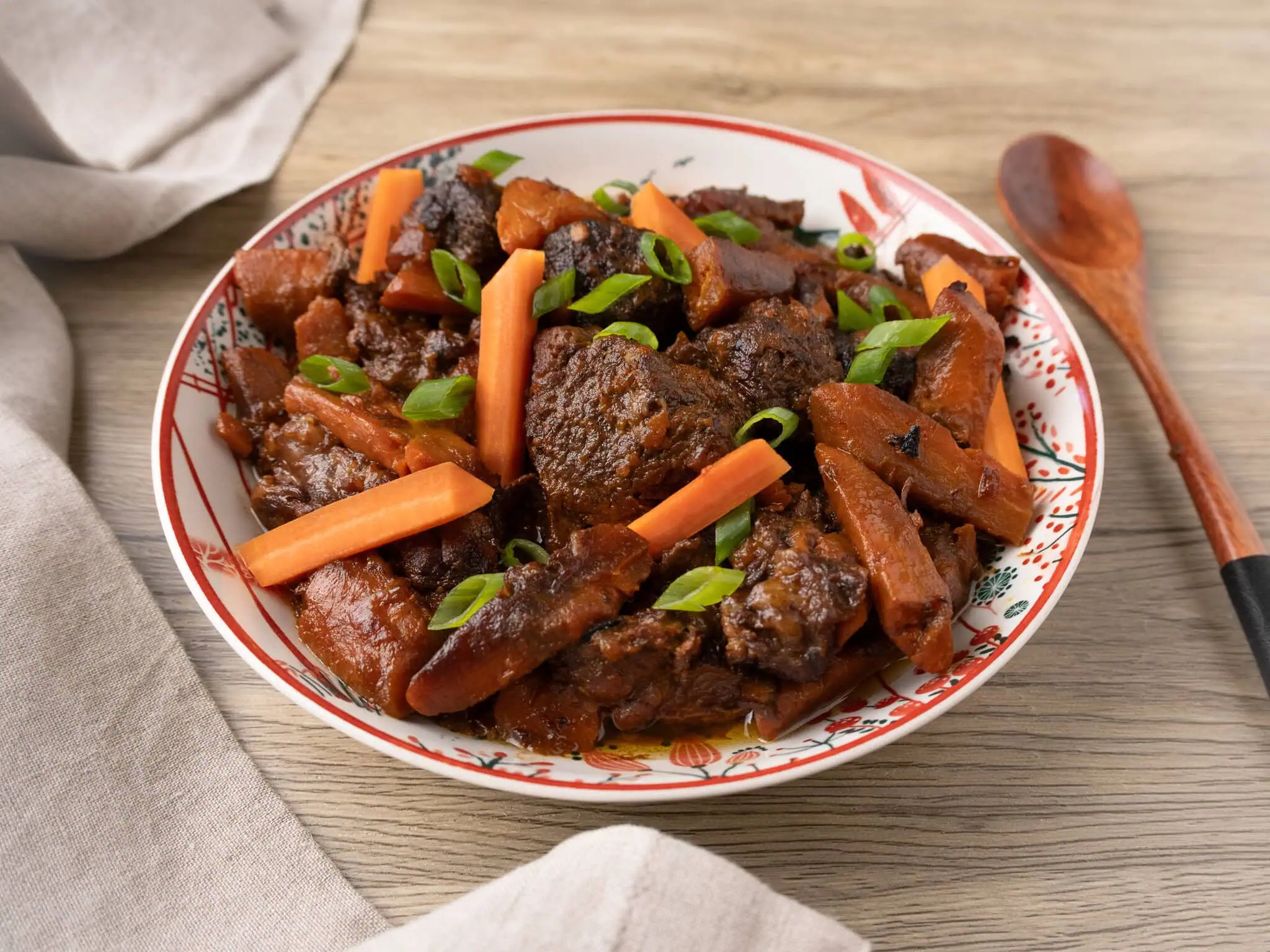
Beef and carrot stew served in a deep, patterned plate

Dutch Oven Beef Stew with Carrots

In France, bœuf carottes almost always means beef and carrots simmered in red wine, often with bacon and mushrooms. So it may seem odd for a French cook to share a beef stew without wine, adapted from a Jamie Oliver recipe. Yet this Dutch oven beef stew is one I make often. It cooks slowly in the oven and calls for just five main ingredients.

What replaces the wine is a bottle most American kitchens already have: Worcestershire sauce. It brings the savory depth and acidity you’d usually get from wine and bacon, and Dijon mustard does the rest. The beef pulls apart with a fork and the carrots turn meltingly tender. As for the sauce, I’d be surprised if you could resist mopping it up with a piece of bread.

You’ll need only about 20 minutes of hands-on time. Brown the meat and vegetables, then let the oven take over for four hours while you get on with your day. If you’re having people over, make it a day ahead. It tastes even better reheated, and you’ll have one less thing to do before dinner.

Published on September 29, 2026

PREP TIME

20 min

COOK TIME

4 hours

DIFFICULTY

Easy

STORAGE

3 days

I found this recipe in Jamie Oliver’s 5 Ingredients, where it’s called Meltin’ Mustardy Beef. He keeps it simple, and I’ve changed very little.

Worcestershire sauce does most of the heavy lifting here. It contains anchovies, which bring the savory, umami depth you’d otherwise get from bacon and mushrooms. Its vinegar and tamarind provide the acidity usually supplied by wine, and its touch of sweetness does the job of the tomato paste.

The mustard mellows over the long cooking time, leaving a gentle warmth by the end. Jamie Oliver uses whole-grain mustard. I prefer Dijon, which, to my taste, gives the sauce a flavor closer to the bœuf carottes I know. For a milder version, use whole-grain mustard instead.

Beef Stew, Step by Step

Carrots and onions browning in a cast-iron Dutch oven, seen from above
1. Carrots and onions browned
Beef cubes browning in a cast-iron Dutch oven, seen from above
2. Beef well seared
Beef, carrots and onions covered with water in the Dutch oven, ready to go in the oven
3. Water, mustard and Worcestershire
Closed cast-iron Dutch oven in the middle of the oven for the slow braise
4. Four hours at 300°F (150°C)

Dutch Oven Beef Stew with Carrots Recipe

Recipe by Hélène Thiers
4.9 from 8 votes

Fork-tender beef, carrots that soak up all the juices, and a lightly tangy mustard sauce you’ll want to mop up with bread. Five main ingredients, four hours in the oven, and very little to do.

Servings

6

servings
Prep time

20

minutes
Cooking time

4

hours 
Cook mode

Pour garder la recette visible pendant que je cuisine

Ingrédients

  • 2 1/4 lb stewing beef, such as chuck, shank, or beef cheeks, cut into 1½-inch (4 cm) chunks

  • 1 lb carrots, plus a few extra to cook separately for serving, if desired

  • 2 medium onions

  • 1 tablespoon Dijon mustard, or whole-grain mustard for a milder flavor

  • 1/2 cup Worcestershire sauce

  • 2 tablespoons neutral oil or butter

  • 3 1/2 cups hot water, depending on the size of your Dutch oven

  • Salt and freshly ground black pepper

  • Chopped fresh parsley, for serving (optional)

Instructions

  • Preheat the oven to 300°F (150°C) on the convection setting, or 325°F (160°C) without convection. Peel the carrots and cut them into 2-inch (5 cm) pieces. Peel and slice the onions.
  • Heat the oil or butter in a large Dutch oven over medium-high heat. Add the carrots and onions and cook until they begin to brown. Remove them from the pot and set aside.
  • Add the beef to the hot pot, working in batches if necessary, and brown on all sides. Avoid crowding the pot, which will cause the meat to steam rather than brown. Season with black pepper.
  • Return the carrots and onions to the pot. Add enough hot water to just cover the meat and vegetables, scraping the bottom to release the browned bits. Stir in the mustard and Worcestershire sauce. Season lightly with salt, keeping in mind that the Worcestershire sauce is already salty.
  • Cover and transfer to the oven. Cook for about 4 hours, checking occasionally and adding a little water if the liquid has reduced too much.
  • The beef is ready when it pulls apart easily with a fork. Taste and adjust the seasoning. Serve right away with mashed or steamed potatoes and a little chopped parsley, if desired, or let cool and refrigerate to reheat the next day.

What’s the Best Cut of Beef for Stew?

Choose a cut suited to slow cooking, such as chuck, beef shank, or beef cheeks. Jamie Oliver uses shin, usually called shank in the United States. These cuts are rich in collagen, which slowly melts into gelatin during a long, gentle braise. That’s what keeps the meat tender and moist instead of drying it out.

In France, I ask my butcher for beef for bourguignon. When we lived in Belgium, I asked for beef for carbonnade, the Belgian beer-braised stew, instead. The cuts are the same, only the name changes. In an American grocery store, chuck roast is a practical choice: you can cut it into evenly sized pieces yourself. Prepackaged stew meat works too, but it’s often a mix of cuts that don’t cook at the same pace.

Cut the beef into generous 1½-inch (4 cm) chunks so they hold together during cooking, just as you would for a lamb tagine.

Why Cook Beef Stew in the Oven?

On the stovetop, a stew needs more attention because the heat comes only from underneath, and the sauce can stick and scorch on the bottom. In the oven, heat surrounds the pot, keeping the cooking gentle and even. This stew cooks at 300°F (150°C) on the convection setting. If your oven doesn’t have convection, use 325°F (160°C). Check it occasionally and add a little water if the liquid has reduced too much.

Before it goes into the oven, take the time to brown the beef well. The browned bits on the bottom of the pot dissolve when you add the water, giving the sauce both color and a deeper, roasted flavor.

What to Serve with Beef Stew

I often serve it with mashed potatoes, preferably with plenty of butter. They remind me of a dinner we once hosted for some of my husband’s colleagues. One of them told us, in all seriousness, that they were the best mashed potatoes he had ever eaten.

He liked the beef stew too, although I think it was his first time trying bœuf carottes. But the potatoes? They were frozen! To be fair, I had stirred in a generous amount of butter and crème fraîche, a little like Joël Robuchon’s famously rich mashed potatoes. A humbling moment that still makes me smile.

Steamed potatoes work very well too. Sometimes I also cook a few extra carrots separately, keeping them crisp-tender, and add them to the serving dish at the last minute. Their bright color and bite contrast nicely with the carrots that have spent hours soaking up the sauce.

For a full meal, start with a chilled beet appetizer topped with horseradish whipped cream, served in small glasses, and finish with an orange salad with lightly spiced caramel. The fresh citrus is especially welcome after a slow-cooked dish.

Hélène Thiers

Made It, or Tempted?

4.9 from 8 votes

I’d love to hear what you think!
Just click the stars above to rate the recipe.

It only takes a second, and it helps other home cooks find recipes they’ll love.

Dutch Oven Beef Stew FAQs

Can I make this beef stew a day ahead?

Yes, and I often do. Let it cool, then refrigerate it promptly in a covered container for up to three days. As the stew cools, the fat rises and sets on the surface. You can skim some of it off with a spoon for a lighter dish, then reheat the stew gently, covered.

The cooking time depends on the cut and the size of the pieces. Put the lid back on and cook for another 30 minutes to an hour, adding a little water if needed, then check again with a fork.

I wouldn’t recommend one here, because Worcestershire sauce gives this stew most of its character. If you cook gluten-free, check the label. In the US, Lea & Perrins is labeled gluten-free, while the version sold in Europe contains malt vinegar made from barley. Ingredients also vary from one brand to another.

Yes, in individual portions stored in airtight containers. Thaw in the refrigerator overnight, then reheat gently on the stovetop.

I’ll admit that I freeze stews less often than I once did. I used to make big batches just to keep some in the freezer. These days, I find that after a long stay in the freezer, the flavors start to blur together and the stew tastes a little flat. That’s entirely a personal impression, and freezing is still a useful way to save leftovers. When I can, though, I prefer to enjoy this stew within a few days of making it.

More Dishes to Share

Two tagines for days when you have time to let dinner simmer, Thai ground pork for busy weeknights, and a chickpea curry for a vegetarian meal.

Lamb tagine with candied kumquats and fava beans, served in terracotta dishes

Kumquat Tagine

Kumquats bring a tart flavor and a hint of bitterness to this slow-cooked dish. Try it if you enjoy citrus in savory recipes.

Lamb tagine with apricots, carrots, and potatoes, topped with sliced almonds

Apricot Tagine

Sweet apricots, spices, and tender meat. I explain how to prepare it and what to watch for as it cooks.

Thai ground pork with bell peppers and basil, served with white rice

Thai Ground Pork

A quick dish with bell peppers and basil, full of flavor and ready to serve with white rice.

Chickpea curry with cherry tomatoes, cilantro, and lime in a cast-iron pot

Chickpea Curry

A vegetarian option with chickpeas and a cool yogurt sauce to serve alongside.

Leave a Comment

Your email address will not be published. Required fields are marked *

*

This site uses Akismet to reduce spam. Learn how your comment data is processed.